Overview
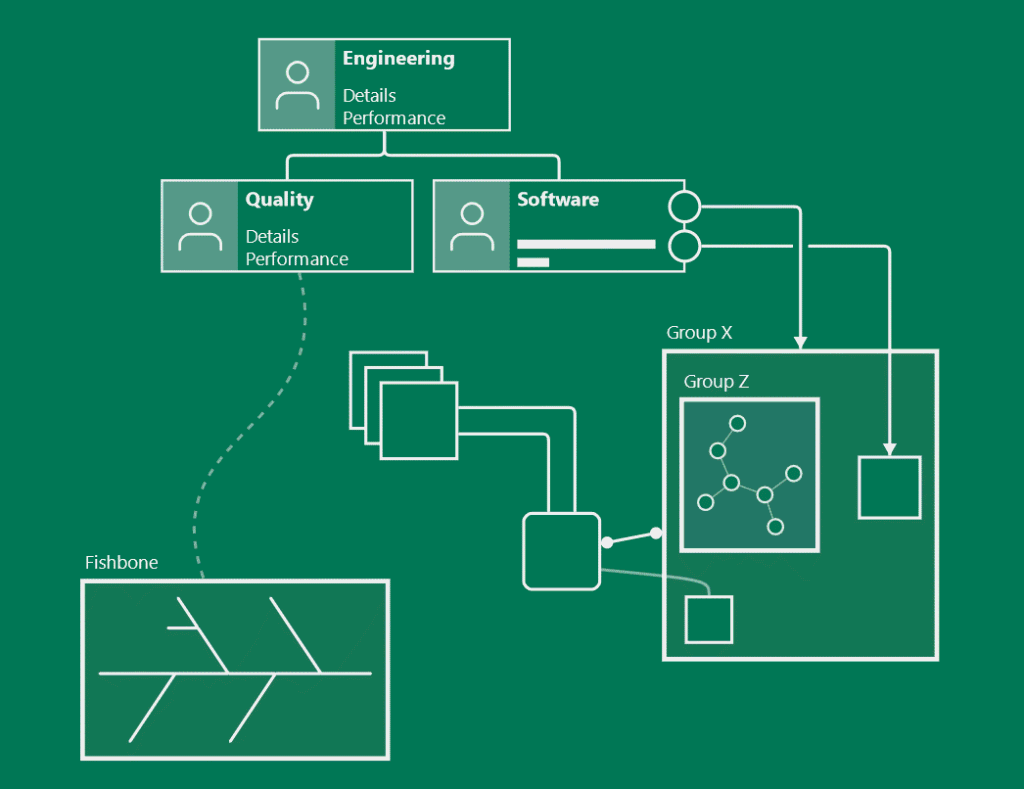
Northwoods GoDiagram is a professional diagramming library designed to help developers add rich, interactive diagrams to their applications. It provides a flexible set of building blocks for rendering nodes, links, and groups, and for enabling user interaction such as dragging, resizing, selecting, and editing. The library is focused on performance and precision, making it suitable for complex diagrams with many elements.
Product Definition
The library offers a comprehensive API that supports custom shapes, templating, automatic layout, and model-driven updates. It is meant for embedding into desktop or web applications where visual representation of structured data is required. By abstracting low level drawing operations and user input handling, it lets development teams focus on domain logic and user experience rather than graphics plumbing.
How It Operates
The core model separates data from view so diagrams are updated when the underlying model changes. Nodes and links are first-class objects that can carry metadata, respond to events, and participate in layout calculations. Interaction is handled through a set of input handlers that support selection, drag and drop, copy and paste, and undo and redo. Layout algorithms can be invoked programmatically or run automatically to arrange elements based on constraints and relationships.
Main Features
- Interactive diagram editing with click, drag, and resize support
- Rich set of built-in shapes and support for custom visual templates
- Advanced link routing and connection tools for clear diagram readability
- Automatic and manual layout algorithms for tree, force, grid, and flow arrangements
- Full undo and redo stack for safe editing and experimentation
- Data binding and model synchronization for two-way updates
- Serialization and deserialization for saving and loading diagrams
- Hit testing and event model for fine-grained interaction handling
- Grouping and nesting of elements for modular diagram composition
- Performance optimizations to handle large diagrams and many elements
Advantages
Using the library can speed up development by providing a ready made, well tested framework for visual editing. Developers gain access to a rich toolset that reduces the need to implement common behaviors such as selection, alignment, and layout. The model driven architecture helps keep application state consistent, which simplifies integration with data sources and business logic.
Designers and product teams benefit from the ability to customize visuals and interaction patterns to match user needs. Because the library focuses on flexibility, teams can implement specialized diagram types, embed editors into larger workflows, and maintain responsive, interactive experiences for end users.
Typical Use Cases
- Building flowchart and process model editors for business and operations teams
- Creating organizational charts and hierarchical views to visualize structure
- Designing network topology and infrastructure maps with live data overlays
- Authoring UML diagrams, ER diagrams, and other technical visuals for development tools
- Embedding interactive dashboards that include relationship visualizations and clickable elements
- Constructing visual editors for workflows, rules engines, and process automation
- Educational tools and interactive documentation that require diagramming capabilities
- Custom applications that need drag and drop node construction, snapping, and constraint enforcement
Final Thoughts
For teams that need to add robust diagramming to their applications, the library offers a balanced mix of ease of use and extensibility. Its component based approach and rich API surface make it possible to implement common diagramming needs quickly while still allowing deep customization for unique requirements. Evaluating the library in a small proof of concept can highlight how it integrates with existing data models and UI frameworks, and can reveal opportunities to accelerate development timelines and improve user interactions.
Whether you are building tools for system design, process documentation, or interactive visualization, the library provides the essential capabilities to craft intuitive, high performance diagram editors that fit into modern application architectures.